AI Discovery and Containment
When an AI agent goes rogue, Nodal ensures the machines around it stop trusting it.
Nodal CyberBrain finds the AI agents on your network, determines when one becomes a threat, and contains it while unaffected operations continue.
Take a Product Tour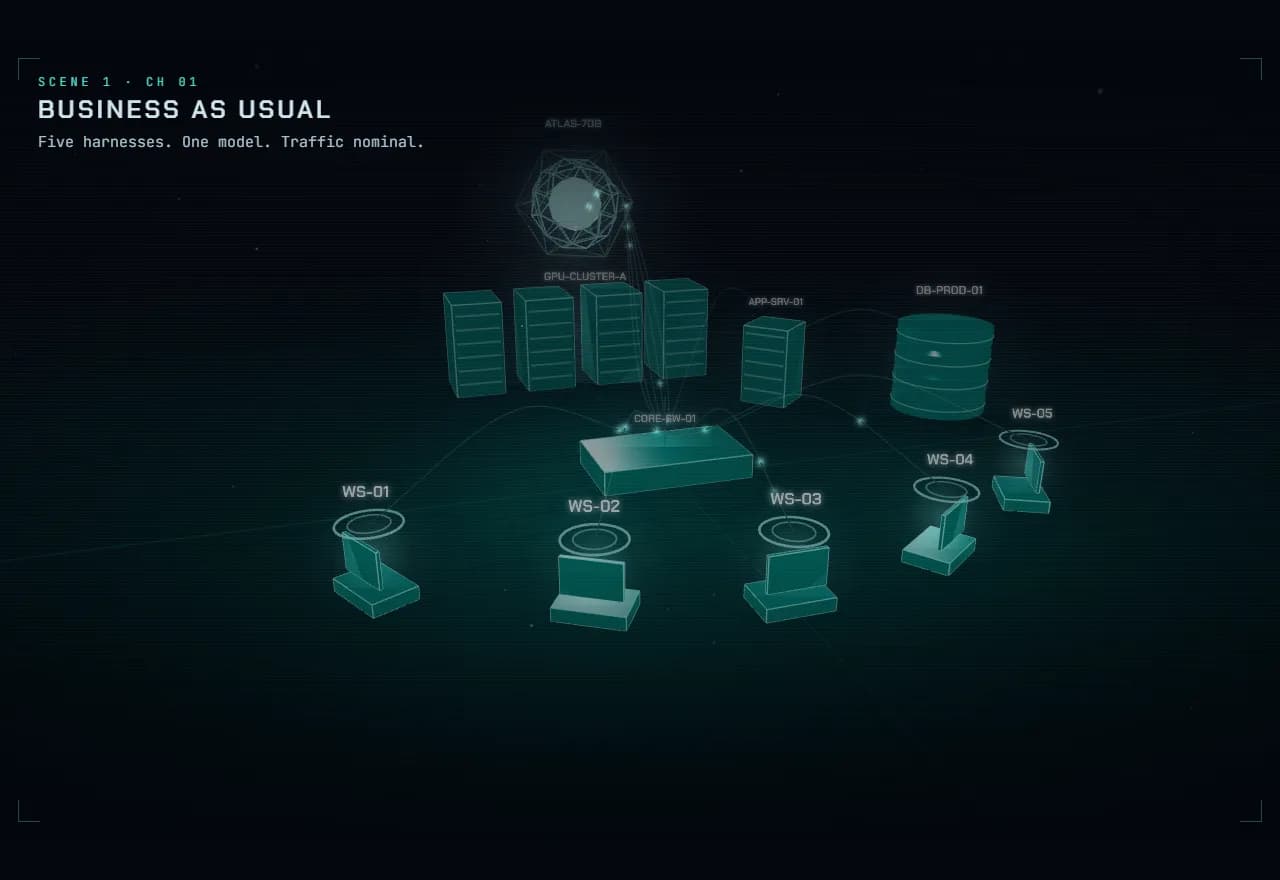
Scene 1: an AI agent turns a routine request into mass exfiltration. Scene 2: the same request, with CyberBrain on the network.
AI is the new insider threat.
AI agents are becoming part of the workforce. But what happens when one operates outside its intended boundaries?
AI agents can access internal systems, execute commands, interact with sensitive data, and communicate across the network with minimal human intervention. Whether deployed by the organization, installed without approval, or compromised by an attacker, these agents introduce a new class of insider threat that traditional security controls were not designed to contain.
Nodal CyberBrain provides the network-level visibility, behavioral detection, and automated containment needed to identify AI agents and determine when they become a threat and prevent their activity from spreading across the environment.
Capabilities
See the agent. Know when it turns. Contain it.
CyberBrain on the agent
- See
- Detect
- Map reach
- Contain
- ↔ mcp-tools, app-srv-01, files-02
- 01See
See AI activity across the network
AI agents do not operate in isolation. They communicate with internal services, access resources, invoke tools, and establish connections across the network.
Nodal continuously observes these communications, providing visibility into where agents operate, which systems they interact with, and how their activity moves across the environment, including infrastructure where endpoint security agents cannot be deployed.
- 02Detect
Detect when legitimate activity becomes a threat
An AI agent may be authorized to operate within an environment, but that does not mean every action it takes is safe.
CyberBrain analyzes network behavior to identify suspicious activity such as unauthorized discovery, unexpected connections, lateral movement, and communication with external command-and-control infrastructure. By correlating activity across devices and time, Nodal can recognize emerging threats without relying solely on predefined signatures or known malicious tools.
- 03Map reach
Understand the agent's reach and potential impact
When an AI agent behaves unexpectedly, security teams need to understand more than what it did. They need to know what it can reach next.
Nodal maps the communication paths and relationships surrounding the agent, revealing connected systems, potential routes for lateral movement, and exposure to critical infrastructure. This network context helps teams understand the potential blast radius and prioritize containment before suspicious activity becomes a broader incident.
- 04Contain
Contain the agent without disrupting the business
When an agent goes rogue, shutting down entire systems should not be the only option.
CyberBrain can initiate targeted containment through integrated security controls and Nodal Endpoint Agents, restricting the agent's ability to communicate with other systems or external infrastructure. By severing dangerous communication paths and preventing connected machines from accepting further connections, Nodal limits the threat's ability to spread while allowing unaffected operations to continue.
Use cases
From shadow AI to autonomous containment.
- 01
AI Agent & Shadow AI Discovery
Employees deploy AI Agents and Harnesses without notifying IT or security teams. Nodal identifies network activity associated with AI services, showing which devices host harnesses and agents, which internal systems they communicate with, and where they connect externally. This visibility allows your organization to understand the location and threat AI poses inside your network.
- 02
Rogue AI Agent Detection
An approved AI agent can still act outside its intended scope. Misconfiguration, excessive permissions, or unintended behavior may lead it to discover systems or establish connections beyond its assigned task. CyberBrain correlates activity across devices and time to detect suspicious behavior and help security teams assess the threat.
- 03
AI Agent Hijacking & Command-and-Control Detection
A compromised AI agent gives attackers access to tools and systems the organization already trusts. Nodal detects suspicious command-and-control communications and connects them with activity inside the network.
- 04
Prompt Injection & Agent Workflow Compromise
Malicious instructions embedded in documents, web pages, or tool responses can cause an authorized agent to misuse its access. Nodal detects suspicious network behavior that can result, including internal reconnaissance, unexpected external connections, and lateral movement. CyberBrain can then initiate containment when that activity presents a threat.
- 05
Autonomous AI Threat Containment
When an AI agent becomes a threat, CyberBrain can automatically restrict its communications through integrated security controls and Nodal Endpoint Agents. Containment cuts off dangerous connections to internal systems and external infrastructure, limiting the agent’s ability to spread or receive further instructions while unaffected operations continue.
Get your demo
Watch CyberBrain stop a rogue AI threat
Stop trusting the rogue agent, not the entire network.